Identification
Herkenning
Identificação
The femaleHet vrouwtjeA fêmeaThe maleHet mannetjeO machoThe larvaDe larveA larva
Verspreiding
De Grote of Gewone glimworm is de bekendste en meest algemene soort. Ze komt voor van Portugal tot Noord-China en van Midden-Finland tot de Kaukasus.
Verspreiding in België
Lampyris noctiluca
komt op verschillende plaatsen in België voor. Ten noorden van
de Samber-Maaslijn wordt ze vooral waargenomen op leemrijke
gronden; op zandgronden, zoals in de Kempen en Zandig Vlaanderen,
lijkt ze veel zeldzamer. Ten zuiden van die lijn is ze zeldzaam
in de Hoge Ardennen en lijkt ze te ontbreken in de Hoge Venen
(naar Magis, 1977).
Nieuwere waarnemingen wijzen erop dat de soort ook in zandige
gebieden vrij algemeen kan zijn, zolang het er nat of vochtig
is. Uit de Kust en Polders zijn nog geen waarnemingen bekend.
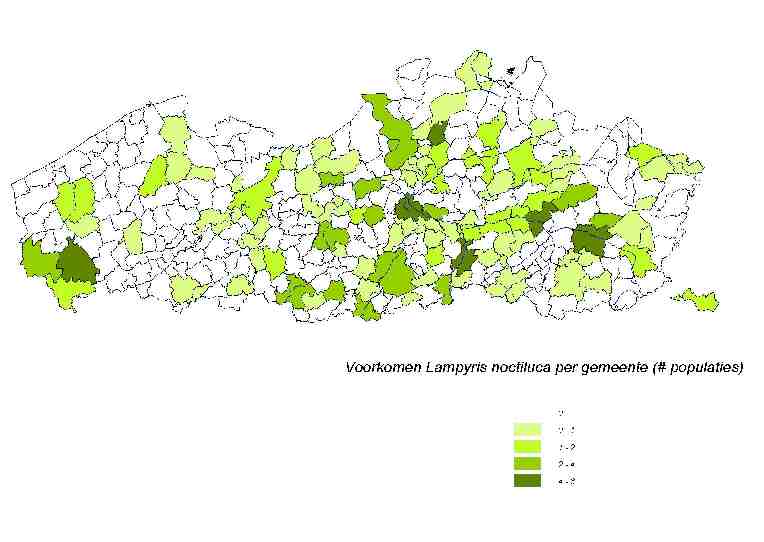
De kaart toont de Belgische gemeenten waar de Grote glimworm
tussen 1990 en 2002 is waargenomen.
Leefgebied
De Grote glimworm leeft in
allerlei gebieden, zolang het er maar vochtig genoeg is. Ze
wordt vaak gevonden op de overgang tussen open en dichtbegroeide
plekken, zoals langs wegbermen, in tuinen, parken, natte
graslanden, ruigten, aan oevers, bosranden, open plekken in
bossen en holle wegen. De larven leven tussen planten, mos,
bladafval en dode bladeren.
Voorbeelden van leefgebieden zijn natte hooilanden, graslanden,
elzenbroekbossen, natte en vochtige bossen (zoals
eiken-haagbeukenbossen), ruigten en struwelen (met bijvoorbeeld
bramen, meidoorn, sleedoorn en wilgen), bosranden, hagen en de
oevers van stilstaand of stromend water.
Verplaatsing en verspreiding
De soort komt over een groot gebied voor. Dat wijst erop dat ze zich relatief goed kan verspreiden. Volwassen glimwormen leven hooguit twee weken. De vrouwtjes zijn ongevleugeld, zeer honkvast en niet aangepast om grote afstanden af te leggen. Uit eigen observaties blijkt dat ze zich hooguit enkele meters verplaatsen. Hoewel de mannetjes niet bijzonder goed vliegen, kunnen ze mogelijk wel zorgen voor uitwisseling van genen tussen (deel)populaties. We weten niet of kunstmatige verlichting, zoals straatlantaarns, mannetjes aantrekt, afschrikt (bijvoorbeeld door de felheid) of geen effect op hen heeft. De verplaatsing naar nieuwe gebieden gebeurt waarschijnlijk vooral in het larvale stadium. Glimwormen brengen 2 tot 3 jaar door als larve en gaan ’s nachts actief op zoek naar prooien. Daarbij leggen ze waarschijnlijk behoorlijke afstanden af als het landschap dat toelaat, bijvoorbeeld als er geschikt leefgebied en verbindingsroutes zijn. Volgroeide larven worden in de lente ook overdag actief en steken dan open terrein over, zelfs op kale grond.
Belang voor natuurbehoud
De Grote glimworm leeft in veel verschillende leefgebieden en
stelt weinig specifieke eisen. Omdat volwassen glimwormen en
larven verschillende plekken kiezen, heeft de soort waarschijnlijk
baat bij een afwisseling van open en meer gesloten begroeiing.
Larven verkiezen dichte begroeiing en een laag bladeren, takjes,
humus en/of mos die vocht vasthoudt. Volwassen glimwormen
verkiezen een opener omgeving, bijvoorbeeld aan de rand van
dichte begroeiing. Daar kunnen ze waarschijnlijk beter met
lichtsignalen communiceren.
De soort is waarschijnlijk gevoelig voor uitdroging, pesticiden
(die ze via slakken binnenkrijgt) en het versnipperen of
verkleinen van haar leefgebied. Doordat ze zich niet ver
verplaatst, kan er minder uitwisseling van genen tussen
populaties plaatsvinden. Dat kan het voortbestaan van
geïsoleerde populaties bedreigen. De invloed van lichtvervuiling
is nog niet duidelijk. Kunstlicht kan populaties mogelijk verder
isoleren: felle straatverlichting kan mannetjes afschrikken,
terwijl licht van grotere afstand hen juist kan weglokken bij
vrouwtjes. Vrouwtjes worden vaak onder straatlantaarns gevonden.
Mannetjes lijken daar het groenige licht van de vrouwtjes niet
goed te kunnen onderscheiden, waardoor voortplanting mogelijk
uitblijft.
Een mogelijk negatief effect van lichthinder blijkt verder nog
uit waarnemingen van larven. Bij sterke lichtvervuiling
(bijvoorbeeld wanneer een zware wolkenlaag 's nachts kunstlicht
terugkaatst) stoppen
de larven met lichtgeven. Uit onderzoek blijkt dat dit gedrag
kan helpen om roofdieren af te schrikken. Het is niet duidelijk of larven in
meer lichtvervuilde omstandigheden kwetsbaarder zijn voor
roofdieren, of dat ze inactief worden, minder voedsel vinden en
zich daardoor trager ontwikkelen.
Range
The common glow-worm is the best-known and most widespread species, ranging from Portugal to northern China and from central Finland to the Caucasus.
Distribution in Belgium
Lampyris noctiluca is reasonably widespread in Belgium. North of the Sambre-Meuse line it occurs mainly in loamy regions and appears much rarer in sandy areas such as the Campine and sandy Flanders. South of the Sambre and Meuse it seems relatively rare in the high Ardennes and absent from the High Fens (after Magis, 1977). Recent records suggest that it can also be fairly common in sandy areas, provided they are wet or damp. No records have yet been received from the coast or the polders. The provisional map shows the Belgian municipalities where the common glow-worm was recorded between 1990 and 2002.
Habitat
The species occurs in a wide variety of habitats, provided they are sufficiently damp. It often favours transitions between closed and open habitats, such as road verges, gardens, parks, wet and damp grasslands, rough vegetation, the banks of ponds, ditches, streams and rivers, woodland edges, forest clearings and sunken lanes. Larvae live among vegetation, moss, litter and dead leaves.
Habitat types include wet meadows on moderately nutrient-poor soils, grasslands on moderately nutrient-rich soils, alder carr, wet and damp woodland (including oak-hornbeam forest), rough vegetation and scrub (including bramble, thorn scrub with hawthorn and blackthorn, and damp willow scrub), woodland margins and hedgerows, and the banks of still or flowing water.
Mobility and dispersal
The species' extensive range points to a relatively good capacity for dispersal. Adults live for only about two weeks. Females are wingless, remain close to where they emerge and are not adapted to travel long distances; observations suggest that they move only a few metres at most. Males are not strong fliers, although they may enable gene flow between subpopulations. The effect of artificial lighting (such as streetlights) on males is unknown: it may attract them, repel them if it is too bright, or have no effect. True migration and colonisation of new areas probably occur mainly during the larval stage. Glow-worms spend two to three years as larvae and forage for prey at night. When the landscape provides suitable habitat and corridors, they may cover considerable distances. Fully grown larvae also become active by day in spring and may cross open ground, including bare surfaces.
Conservation
The common glow-worm uses a broad range of habitats and is not very selective. Because adults and larvae choose different microhabitats, the species probably benefits from a mix of open and closed vegetation or habitat structures. Larvae favour dense vegetation and/or a litter layer of leaves, twigs, loose humus and/or moss with relatively high humidity. Adults prefer more open places, for example at the edge of dense vegetation, probably to communicate using light signals.
The species is likely to be sensitive to drying out, pesticide use (taken up through its snail prey), habitat fragmentation and habitat loss. Its relatively low mobility may affect gene flow and dispersal, and therefore the persistence of isolated populations. The contribution of light pollution is not yet known. Artificial lighting may add to isolation if bright streetlights repel males. Attraction from farther away may also be harmful if males are drawn away from populations with females. Females are often found beneath streetlights; males apparently cannot distinguish their greenish glow there, and the females may consequently fail to reproduce.
Observations of larvae also suggest a possible adverse effect of light pollution. Under heavily light-polluted conditions (for example, thick cloud reflecting artificial light at night), larvae stop glowing. Research indicates that this behaviour may function as an anti-predator signal. It remains unclear whether larvae in more light-polluted areas are more vulnerable to predation, or instead become inactive and fall behind in foraging and development.
Distribuição
O pirilampo-comum é a espécie mais conhecida e com a distribuição mais ampla: ocorre desde Portugal até ao norte da China e da Finlândia central ao Cáucaso.
Distribuição na Bélgica
Lampyris noctiluca encontra-se relativamente disseminado na Bélgica. A norte da linha Sambre-Mosa ocorre sobretudo em zonas argilosas e parece ser muito mais raro em áreas arenosas, como a Campine e a Flandres arenosa. A sul dos rios Sambre e Mosa parece ser relativamente raro nas zonas altas das Ardenas e não ocorre nas Hautes Fagnes (segundo Magis, 1977). Observações recentes indicam que também pode ser relativamente comum em zonas arenosas, desde que sejam húmidas. Ainda não foram recebidos registos da costa ou dos pólderes. O mapa provisório mostra os municípios belgas onde a espécie foi registada entre 1990 e 2002.
Habitat
A espécie ocorre numa grande variedade de habitats, desde que sejam suficientemente húmidos. Prefere muitas vezes zonas de transição entre habitats fechados e abertos, como bermas de estradas, jardins, parques, prados húmidos, vegetação alta, margens de charcos, valas, ribeiros e rios, orlas e clareiras de bosques e caminhos encaixados. As larvas vivem entre a vegetação, o musgo, a folhada e as folhas mortas.
Os habitats incluem prados húmidos em solos moderadamente pobres em nutrientes, pastagens em solos moderadamente ricos em nutrientes, amieirais paludosos, bosques húmidos (incluindo carvalhais e bosques de carvalho e carpa), vegetação alta e matos — como silvas, sebes espinhosas de pilriteiro e abrunheiro e salgueirais húmidos —, orlas florestais, sebes e margens de águas paradas ou correntes.
Mobilidade e dispersão
A ampla distribuição da espécie indica uma capacidade de dispersão relativamente boa. Os adultos vivem apenas cerca de duas semanas. As fêmeas não têm asas, permanecem perto do local onde emergem e não estão adaptadas a percorrer longas distâncias; as observações sugerem que se deslocam, no máximo, alguns metros. Os machos não são bons voadores, embora possam permitir o fluxo genético entre subpopulações. Não se sabe como a iluminação artificial, como a iluminação pública, os afeta: pode atraí-los, afastá-los se for demasiado intensa ou não ter qualquer efeito. As verdadeiras migrações e a colonização de novas áreas ocorrem provavelmente sobretudo durante a fase larvar. As larvas vivem dois a três anos e procuram alimento à noite. Quando a paisagem oferece habitats e corredores adequados, podem percorrer distâncias consideráveis. Na primavera, as larvas já desenvolvidas também se tornam ativas durante o dia e podem atravessar espaços abertos, incluindo superfícies sem vegetação.
Conservação
O pirilampo-comum utiliza muitos tipos de habitat e não é muito exigente. Como os adultos e as larvas escolhem micro-habitats diferentes, a espécie beneficia provavelmente de uma combinação de vegetação aberta e fechada ou de diferentes estruturas de habitat. As larvas preferem vegetação densa e/ou uma camada de folhas, ramos, húmus solto e/ou musgo com bastante humidade. Os adultos preferem locais mais abertos, por exemplo junto à vegetação densa, provavelmente para comunicarem através de sinais luminosos.
A espécie poderá ser sensível à secagem do habitat, ao uso de pesticidas (que podem ser ingeridos através das suas presas, os caracóis), à fragmentação e à perda de habitat. A mobilidade relativamente reduzida pode afetar o fluxo genético e a dispersão, dificultando a sobrevivência de populações isoladas. Ainda não se conhece o efeito da poluição luminosa. A iluminação artificial pode aumentar o isolamento se candeeiros intensos afastarem os machos. Também pode ser prejudicial atraí-los de longe para fora das populações onde se encontram as fêmeas. Encontram-se muitas vezes fêmeas debaixo de candeeiros; aparentemente, os machos não distinguem aí o seu brilho esverdeado, pelo que essas fêmeas podem não se reproduzir.
As observações das larvas também apontam para um possível efeito negativo da poluição luminosa. Em locais muito iluminados à noite — por exemplo, quando nuvens densas refletem a luz artificial — as larvas deixam de brilhar. A investigação indica que este comportamento poderá funcionar como sinal de defesa contra predadores. Ainda não se sabe se as larvas de zonas mais poluídas pela luz ficam mais vulneráveis a serem comidas ou se, pelo contrário, se tornam inativas e acabam por procurar menos alimento e desenvolver-se mais lentamente.